
Copper
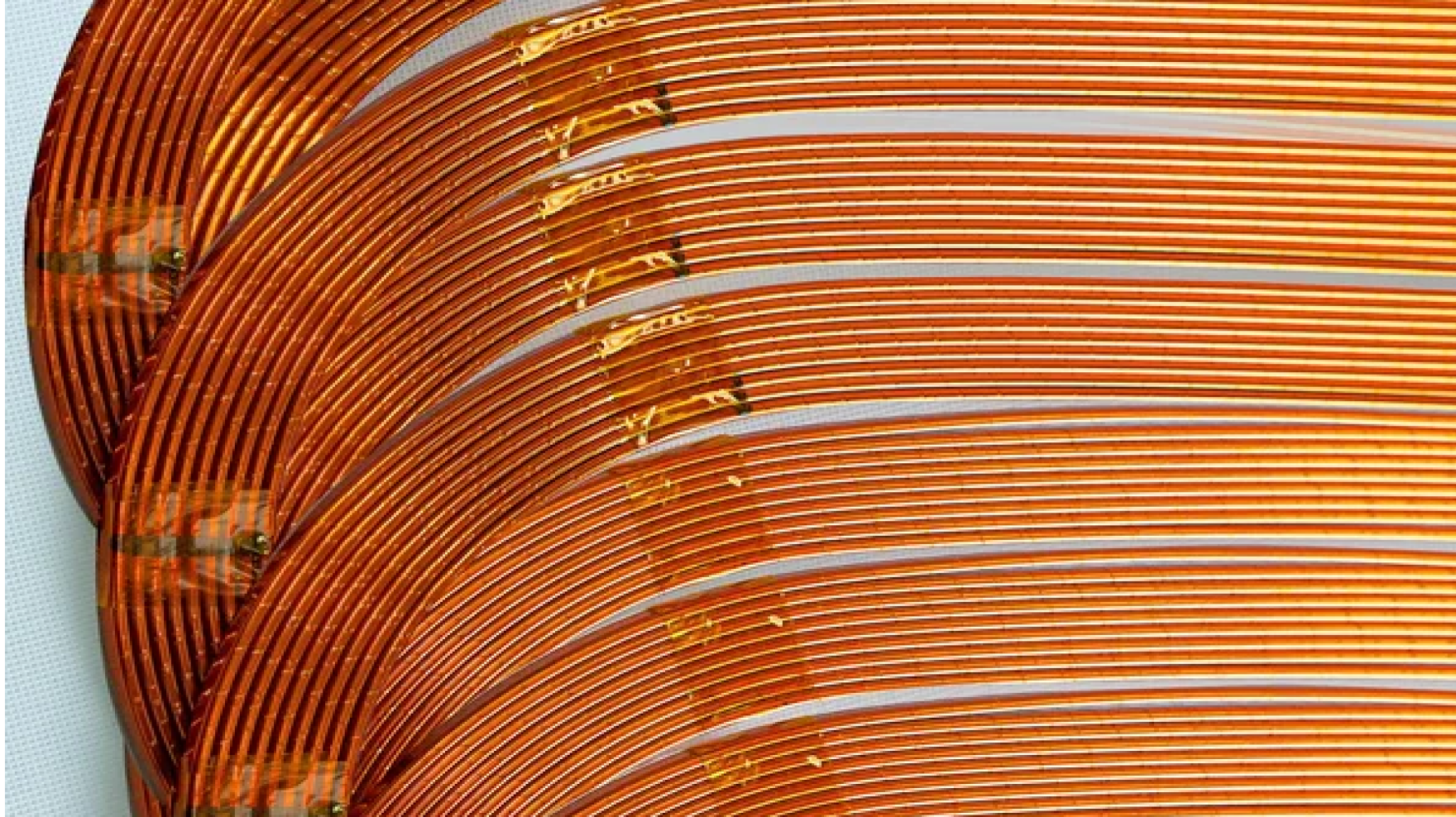
One of the most important characteristics of electrical machines is the efficiency factor (efficiency). Efficiency is the ratio of useful power to consumed power and shows how efficient the machine operates. The difference between consumed and useful power is completely formed due to various losses in the electric machine. All losses are combined in 5 groups: losses in the stator iron, friction losses, stator winding losses, rotor winding losses, stray losses.
Stator winding losses may be up to 35% of the total losses, rotor winding losses - up to 21%. These losses are caused by heat release, skin-effect and other causes. Therefore, strict requirements are specified to materials stator and rotor windings are made of, namely to copper.
Copper is one of the first metals well developed by man, which is mainly due to availability and low melting point. In its native state this metal is more common than gold, silver and iron.
Copper is a golden-pink plastic metal. In the air the metal is oxidized and covered with oxide film, which gives it an intense yellowish-red tint. The oxide film provides protection against corrosion. Copper has high heat and electrical conductivity. In terms of electrical conductivity, it is second only to silver (Figure 1).
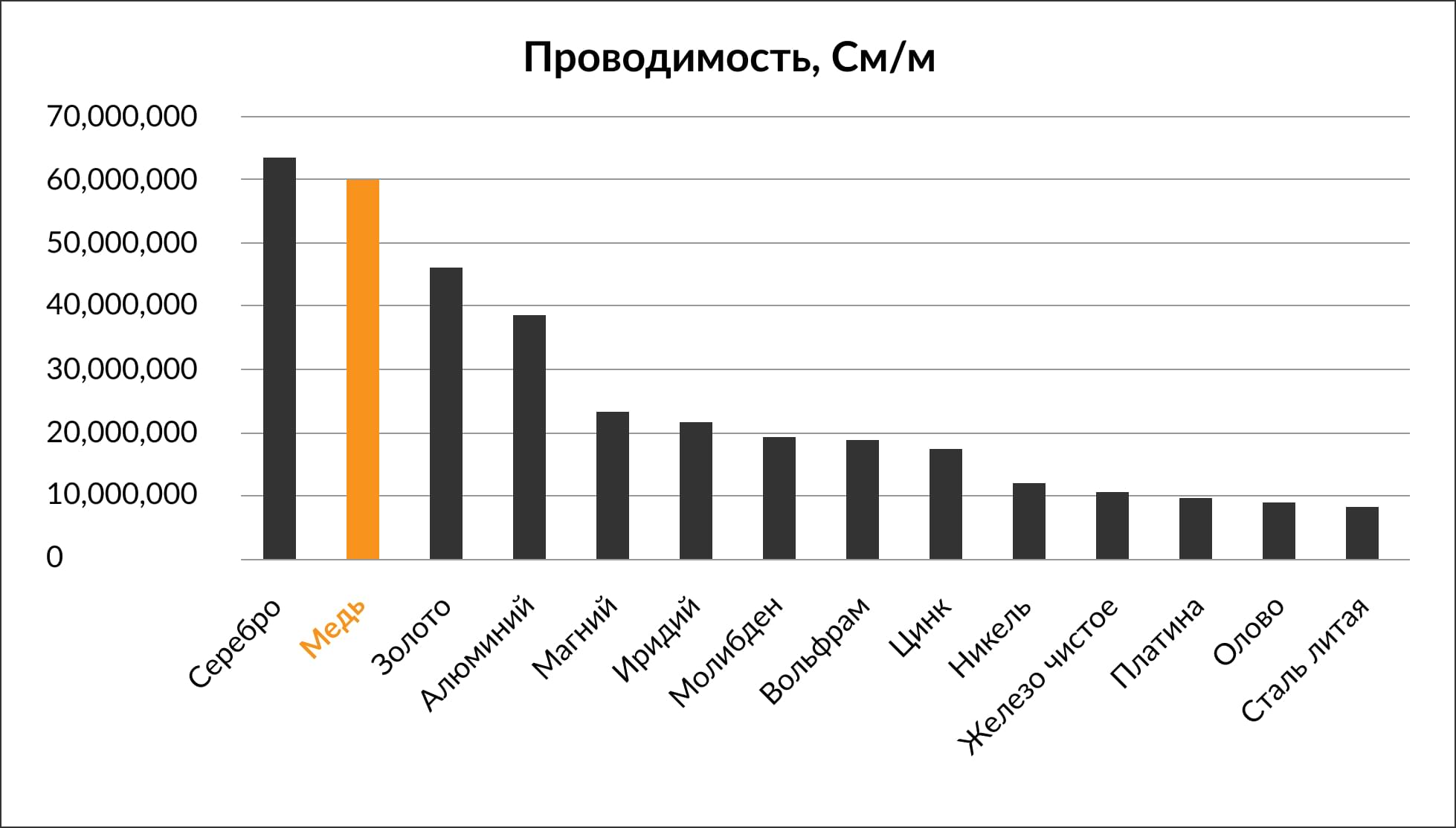
Figure 1 - Metal conductivity
Due to its properties copper and its alloys are widely applied in various fields of industry. First of all, in the electrical engineering. In particular, windings of electric motors stators and rotors are made of this material. The most valuable for electrical engineering is high electrical conductivity of copper (low resistivity).
In 1913, the International Electrical Commission (IEC) established anneal-copper resistivity equal to 0.017241 Ohm*mm2/m at 20°С.
Russian state standard establishes copper resistivity equal to 0.01707 Ohm*mm2/m for rod (GOST 53803-2010) and 0.01724 Ohm*mm2/m for wire (GOST 434-78) at 20°С.
Pure copper, which has the least resistance, is too soft; it is difficult to process it into products. Therefore, at the stage of copper production various impurities are added to adjust physical properties to the required. And almost any impurity has an effect on copper resistance.
For example, an increase in the share of oxygen in copper by 0.01% results in an increase in resistance by 0.12%; an increase in antimony content by 0.05% results in 0.15% increase in resistance.
Getting copper cathodes or high frequency wire is quite difficult and expensive. That's why electrical copper grades were developed. The maximum concentrations of impurities are defined for each grade. Cross reference of grades under Russian and foreign standards is given in Table 1.
| Rusia (GOST 859) | BS EN 1412:1996 | EE.UU. (ASTM:58A-77, B133, B152, B359 |
|---|---|---|
| М00к | Cu-CATH-1 | — |
| М1к | Cu-CATH-2 | — |
| М00, М0б | Cu-ETP1 | C10200 |
| М0, М1 | Cu-ETP | C11100 |
| М2 | — | C12500 |
Table 1 - Copper grades.
Russian standard GOST 434 for copper wire for electrical purposes allows for using copper not lower than M1 grade. This grade has resistance of 0.01724 Ohm*mm2/m, and, for example, M2 copper grade has resistance of 0.01874 Ohm*mm2/m (according to Copper Development Association Inc.). The difference in M1 and M2 grades resistance is 8.7%.
Application of copper wires made of M2 grade and below for manufacturing stator windings can result in a significant change in resistance, lead to increase in winding losses, stray losses, which will reduce efficiency of the machine in general. With constant load on the electric motor the reduced efficiency will lead to increased electricity consumption and to a significant increase in operating costs. If we consider specific figures, the use of M2 grade copper for windings results in a decrease in the efficiency of the machine by 0.35%, when considering growth of electric losses (I2R) only.
Let's look at some examples
An asynchronous electric motor with a capacity of 4000 kW has efficiency of 96%. When using M2 grade copper for stator winding, the efficiency will decrease up to 95.6%. It would seem a slight decrease in efficiency, but it can lead to a significant overpayment for electricity. At a cost of 5 rubles ($0,7, €0,65) per 1 kW*h, the yearly losses for machine will amount to almost 700,000.00 rubles ($9500.00, €9000,00).
A synchronous electric motor with a capacity of 6300kW has efficiency of 97.6%, with M2 copper the efficiency reduces to 97.3%, which in monetary terms is more than 1,000,000,00 rubles ($14000.00, €13000.00 ) annually.
For enterprises with extensive fleets of electric motors, these are considerably significant losses that can be avoided by using quality materials and controlling incoming products.
There are several ways to control the quality of copper wire or rod.
The first method is based on the resistance measurement of copper conductor segment and following calculation of resistivity. The resulting value should not exceed 0.017241 Ohm*mm2/m.
The second method is based on spectrometric analysis of samples. By doing so the share of all impurities is determined and copper grade is specified.